If there is one word that continues to define the channel, it would be volume. More vendors. More products. More announcements. More urgency to move quickly and be seen to act.
What has become increasingly clear, however, is that volume alone does not create value. In many cases, it does the opposite.
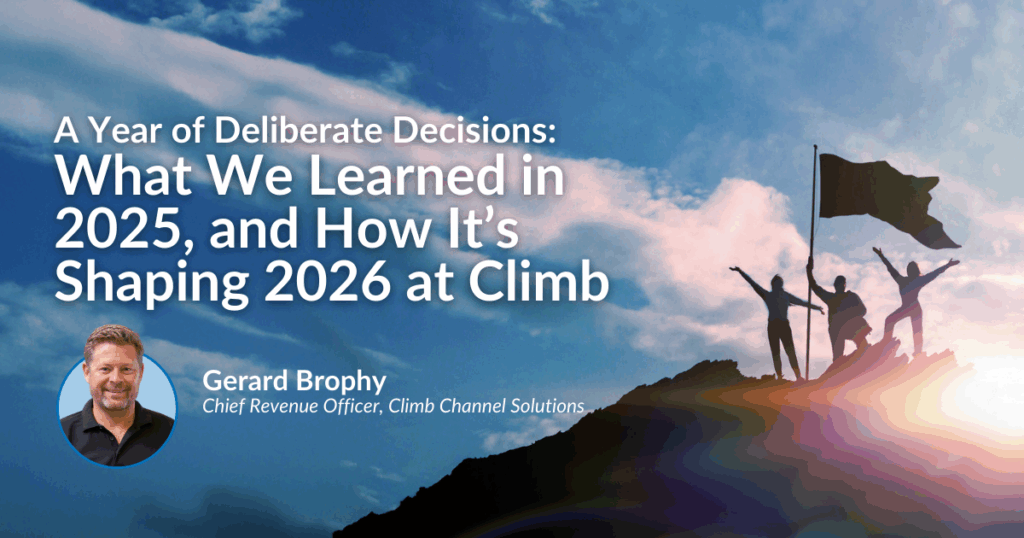
For us at Climb, the past year was not about doing more, or shouting louder about doing more. It was about being deliberate. About narrowing our focus, strengthening the right relationships, and being honest about where we genuinely add value as a distributor in a market that has become increasingly crowded and, at times, unpredictable. Those decisions now shape how we are approaching 2026 and beyond.
Why consolidation matters – and why it is intentional
The technology ecosystem has never lacked innovation. What it has often struggled with is differentiation. Some distributors now carry tens of thousands of vendors, and from a distance, that can look impressive. But from a partner or vendor perspective, it raises the question: why would anyone want to be one of thousands?
Over the past year, we have deliberately reduced the surface area of our portfolio. We have moved from breadth to depth, focusing on a much smaller number of vendors that account for the majority of our gross profit. In EMEA, that means concentrating on a tightly defined group of vendors, with minimal overlap and a clear reason for each relationship to exist.
This is not about exclusivity for its own sake. It is about relevance. Too much overlap slows enablement, fragments investment, and ultimately makes it harder for partners to feel confident in what they are taking to market. One of the clearest lessons we carry into 2026 is that clarity scales success better than abundance.
The same thinking sits behind every new vendor relationship we have signed this year. Whether that is Delinea, Nitro, or others across our core portfolio, we always ask the same question: does this vendor materially improve what our partners can offer, at a price point and level of maturity that reflects real-world market conditions?
If the answer is not an obvious yes, we are comfortable walking away.
Relationships are not a soft metric
It is easy to talk about relationships and culture in abstract terms. At Climb, 2025 was about taking both seriously.
Volatile markets have a way of exposing weak alignment very quickly. When budgets tighten, priorities change, or technology cycles accelerate, trust stops being a nice-to-have. It becomes mission critical.
Over the past year, we have placed even greater emphasis on long-term alignment with both vendors and partners. That means being clear about what we can and cannot support, investing where there is shared intent, and resisting the temptation to chase short-term opportunities that distract us from our core focus.
AI, education, and the reality of adoption
No reflection on the past year would be complete without talking about AI. It has dominated the conversation all year – and that conversation has been loud, urgent, and often contradictory.
From our perspective, AI represents a genuine generational change. Not because of any single model or product but because of how it reshapes the relationship between infrastructure, data, security, and business processes. Comparisons to earlier inflection points, including the dot-com era, are easy to make. We have seen this level of excitement before.
What feels different this time is the scale of capital involved, and the uncertainty that sits alongside it. Vast investment is already tied up in data centres, energy, and real estate. Yet there is still limited clarity around long-term economics, levels of debt, and where sustainable value will ultimately be created. That combination makes for a powerful market, but not a predictable one.
There will be winners and losers. There may well be corrections along the way.
Against that backdrop, we were clear about the role we needed to play in 2025. We are not an AI business. We are a distribution business. Our responsibility was not to add to the noise, but to help partners approach AI with structure, context, and a healthy dose of realism.
That thinking sits behind the Skyward Project and our AI Academy. Across multiple events in Europe this year, we saw strong engagement not only from partners but from a growing number of end users – people closer to budgets, accountability, and long-term decision-making.
Many of our discussions at these events have focused on outcomes, data readiness, security, sovereignty, and how AI fits into existing operating models without introducing unnecessary risk. The appetite was for understanding first, not acceleration for its own sake.
This reinforced something we have seen time and again: confidence comes before commitment. Education creates the conditions for sustainable adoption, particularly in areas as complex and far-reaching as AI. That is why we were deliberately selective this year, reviewing hundreds of emerging vendors globally and signing only a small number. Most AI use cases are highly specific, and the cost of backing the wrong approach – operationally, commercially, and reputationally – is high.
As we move through 2026, we will continue to build on that foundation. Alongside training and enablement, we will expand the services that help organisations move from AI understanding to execution.
From point products back to ecosystems
Over the past decade, the channel gravitated towards highly specialised point solutions. In many cases, that focus was justified. It solved real problems quickly.
What has become clearer more recently is the limitation of that fragmented approach. AI, in particular, cuts across infrastructure, data platforms, security controls, and operational workflows. Isolated tools struggle to address that complexity on their own. As a result, we are seeing renewed interest in ecosystem thinking.
This will shape our approach this year, particularly as we continue to invest in managed services, security, and infrastructure alongside emerging technologies.
Looking ahead
The past year was about choosing focus over noise. In 2026, we’re executing on that focus consistently. That means continuing to be selective, continuing to invest in education and services, and continuing to prioritise relationships that stand the test of time.
The market will remain uncertain. Technology cycles will continue to compress. Our response will remain the same: deliberate decisions, clear intent, and a commitment to helping partners navigate change without unnecessary complexity.
We look forward to continuing that work throughout the year ahead.